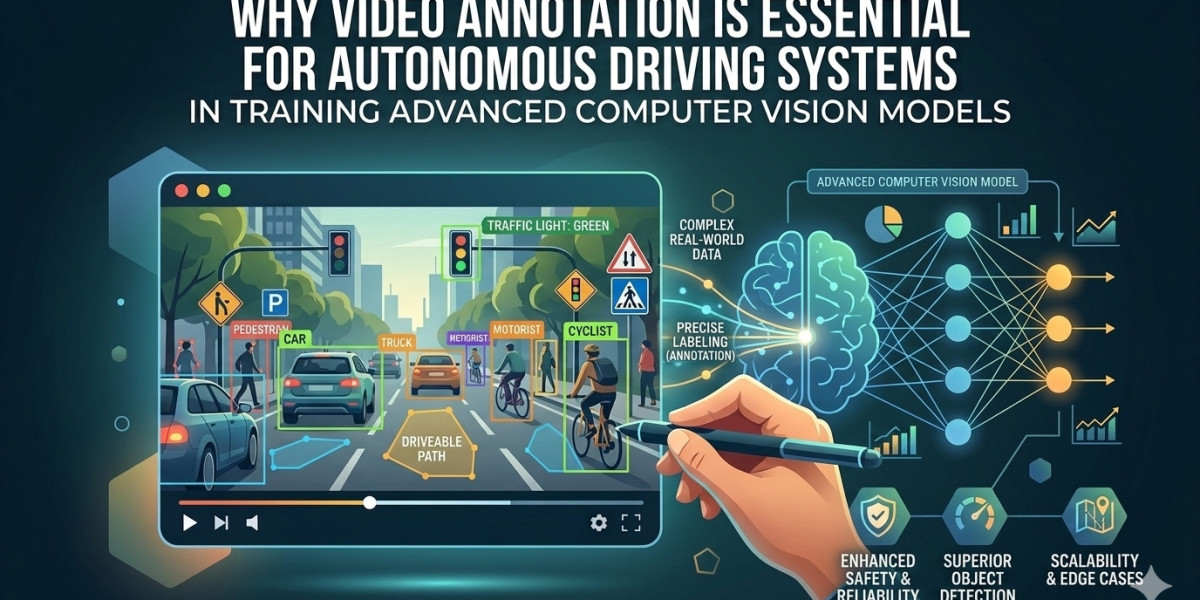

Autonomous driving technology is rapidly transforming the future of transportation. From advanced driver assistance systems (ADAS) to fully self-driving vehicles, artificial intelligence (AI) plays a central role in enabling vehicles to perceive their surroundings, interpret complex road scenarios, and make safe driving decisions. At the core of these intelligent systems lies high-quality training data, and one of the most critical components of that data is video annotation.
Video annotation provides labeled information within video frames that helps machine learning models recognize objects, track movement, and understand dynamic environments. For autonomous vehicles, which rely heavily on camera-based perception systems, video annotation is indispensable. Without accurately annotated video data, AI models cannot effectively learn how to interpret real-world driving situations.
As a trusted data annotation company, Annotera delivers scalable and high-precision video annotation solutions that empower organizations to build safer and more reliable autonomous driving systems.
Understanding Video Annotation in Autonomous Driving
Video annotation is the process of labeling objects, events, and movements within video frames so that machine learning models can learn to detect and interpret them. In autonomous driving systems, this process involves identifying a wide range of elements present on the road, such as vehicles, pedestrians, traffic signals, road signs, lane markings, cyclists, and obstacles.
Unlike static image annotation, video annotation adds a temporal dimension. Objects are tracked across multiple frames, enabling AI models to understand motion, predict trajectories, and analyze interactions between different road participants.
For example, when a pedestrian starts crossing the street, the vehicle’s perception system must recognize the person, track their movement, estimate speed, and predict their future position. Accurate video annotation makes it possible for AI models to learn these behaviors during training.
A professional video annotation company ensures that each frame is labeled consistently and precisely, which significantly improves the performance of computer vision algorithms used in autonomous vehicles.
Enabling Accurate Object Detection
Object detection is one of the most fundamental capabilities required for autonomous driving. Vehicles must be able to detect and classify various objects in real time to avoid collisions and navigate safely.
Video annotation enables AI models to learn how to identify objects such as cars, buses, motorcycles, pedestrians, animals, traffic lights, and road barriers. Annotators use techniques like bounding boxes, semantic segmentation, and polygon annotation to define the exact location and shape of objects within each frame.
The diversity of real-world environments—urban roads, highways, construction zones, and rural areas—means that autonomous systems must be trained on massive volumes of annotated video data. This is why many companies rely on data annotation outsourcing to scale their datasets efficiently while maintaining high-quality labeling standards.
By partnering with a reliable data annotation company like Annotera, organizations can ensure their AI models are trained with accurate and consistent data that supports robust object detection.
Improving Motion Tracking and Behavior Prediction
Driving environments are dynamic, and objects are constantly moving. Autonomous vehicles must not only detect objects but also track them across time and predict their future behavior.
Video annotation enables multi-object tracking by linking the same object across consecutive frames. For instance, a cyclist riding along the road must be tracked frame by frame so the system understands their trajectory and potential interactions with the vehicle.
Through video annotation, machine learning models can learn patterns such as:
Pedestrians slowing down before crossing the road
Vehicles merging into adjacent lanes
Cyclists changing direction
Cars braking suddenly in traffic
These patterns allow autonomous systems to anticipate potential hazards and respond appropriately.
Accurate motion tracking requires meticulous annotation, which is why many AI developers prefer video annotation outsourcing to specialized providers who have the expertise and workforce needed to handle complex video datasets.
Supporting Lane and Road Structure Detection
Understanding road infrastructure is another critical function for autonomous vehicles. Vehicles must recognize lane boundaries, road edges, intersections, crosswalks, and traffic signals to navigate safely.
Video annotation helps train AI models to detect and interpret these road elements. Annotators often use semantic segmentation or polygon annotation techniques to outline lane markings, road surfaces, and sidewalks.
For example, autonomous vehicles must distinguish between different types of lanes, such as:
Driving lanes
Turning lanes
Bike lanes
Bus lanes
They also need to recognize temporary changes in road conditions, such as construction zones or detours.
Accurate video labeling ensures that autonomous driving systems can correctly interpret road structures even in challenging environments such as poor lighting, rain, fog, or heavy traffic.
Handling Complex Real-World Scenarios
Real-world driving conditions are unpredictable and complex. Autonomous vehicles must be trained to handle countless scenarios, including unusual road situations that may occur rarely but still require safe responses.
Video annotation enables AI models to learn from diverse real-world driving situations, including:
Heavy traffic congestion
Pedestrian crossings in crowded areas
Emergency vehicles approaching
Road debris or obstacles
Sudden braking or lane changes
These scenarios require detailed and context-aware annotations to ensure that the AI system understands not only what objects are present but also how they interact.
A specialized video annotation company can build comprehensive datasets that cover a wide range of real-world driving conditions, ensuring that AI systems are well-prepared for real-world deployment.
Enhancing Safety and Reliability
Safety is the most critical factor in autonomous driving development. Even a minor perception error can lead to serious consequences. High-quality video annotation plays a key role in minimizing these risks by ensuring that machine learning models are trained with precise and reliable data.
When annotation quality is inconsistent or inaccurate, AI models may learn incorrect patterns, which can lead to poor performance in real-world scenarios. This is why rigorous quality assurance processes are essential during the annotation process.
At Annotera, multiple layers of quality control ensure that annotated datasets meet strict accuracy standards. By combining human expertise with advanced annotation tools, the company delivers reliable training data that supports safer AI systems.
Organizations increasingly rely on data annotation outsourcing to access experienced annotators, structured workflows, and scalable resources without the overhead of building in-house annotation teams.
Accelerating AI Development and Deployment
Developing autonomous driving technology requires enormous volumes of labeled video data. Managing such large datasets internally can be time-consuming and resource-intensive.
By partnering with a dedicated data annotation company, automotive and AI companies can accelerate their development cycles. Professional annotation teams can process large-scale datasets efficiently while maintaining high accuracy and consistency.
Video annotation outsourcing also enables organizations to scale their operations quickly as project requirements grow. This flexibility is particularly valuable for companies conducting large training experiments or developing new autonomous driving models.
Annotera provides end-to-end annotation services designed to support fast and reliable AI development. With expertise in video annotation, polygon annotation, and complex computer vision datasets, Annotera helps organizations transform raw video footage into structured training data that powers intelligent driving systems.
The Future of Autonomous Driving and Data Annotation
As autonomous driving technology continues to evolve, the demand for high-quality annotated data will grow significantly. Future systems will rely on increasingly sophisticated AI models that require even more detailed and diverse training datasets.
Advancements such as multi-sensor fusion, combining camera data with LiDAR and radar inputs, will further increase the complexity of annotation tasks. Video annotation will remain a critical component of this ecosystem, enabling AI systems to understand and navigate real-world environments safely.
Reliable annotation partners will play a key role in supporting the next generation of autonomous mobility solutions.
Conclusion
Video annotation is a foundational element in the development of autonomous driving systems. It enables AI models to detect objects, track motion, understand road structures, and interpret complex driving scenarios. Without accurately annotated video data, machine learning algorithms cannot achieve the level of perception and decision-making required for safe autonomous vehicles.
By leveraging professional video annotation outsourcing, organizations can access high-quality labeled datasets that accelerate AI development while maintaining strict accuracy standards.
As a leading data annotation company, Annotera provides scalable and precise video annotation services tailored to the needs of autonomous vehicle developers. Through expert-driven annotation workflows and rigorous quality assurance, Annotera helps organizations build the reliable AI systems that will shape the future of transportation.