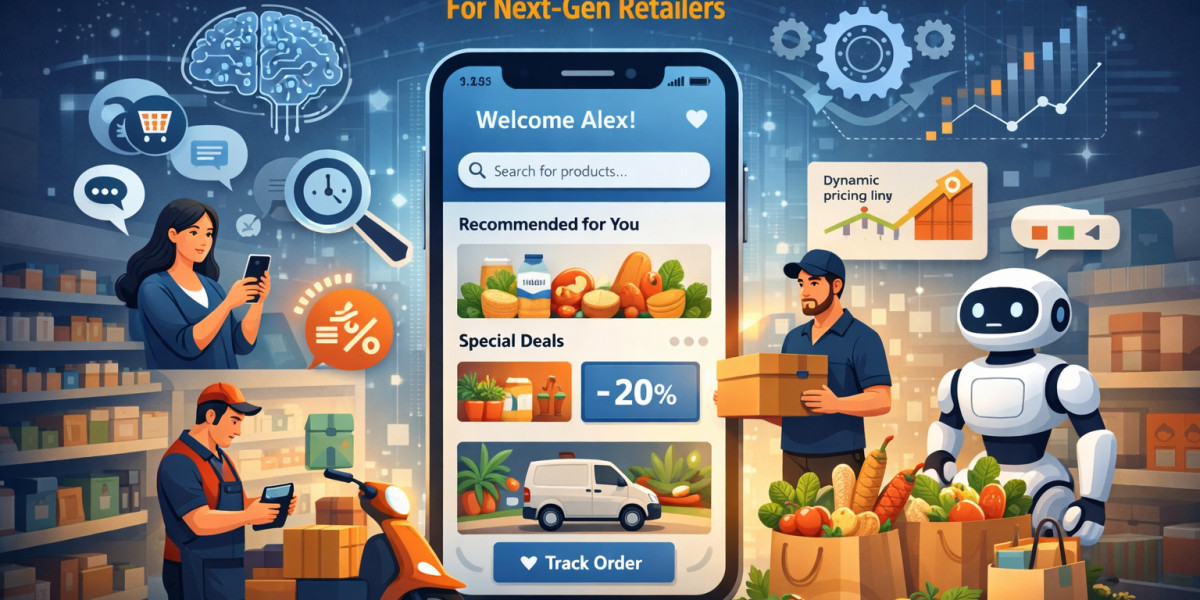

The grocery industry is no longer driven only by location, discounts, and product variety. Today, it is powered by speed, personalization, inventory intelligence, and customer experience. Customers expect instant search, accurate delivery times, smart recommendations, easy reordering, real-time tracking, and seamless payments. At the same time, grocery businesses need tighter control over inventory, delivery costs, demand forecasting, and customer retention.
That is exactly where an AI-powered grocery app development company becomes essential for next-gen retailers. Instead of building a basic grocery ordering app, modern retailers are investing in AI-enabled platforms that can automate operations, reduce waste, increase repeat orders, and deliver a more personalized shopping journey.
This guide explains what AI-powered grocery app development means, what features matter, which AI capabilities drive real ROI, how the development process works, and how to choose the right company for your grocery app.
What Is AI-Powered Grocery App Development and Why It Matters for Modern Retail
AI-powered grocery app development refers to building a grocery ordering platform where artificial intelligence is integrated into the user experience and business operations. This is not limited to chatbots or “recommended products.” True AI-powered grocery apps use machine learning models, predictive analytics, and automation to improve decisions across the platform.
For next-gen retailers, AI is not just a competitive advantage. It becomes a survival tool because grocery is a low-margin industry. Small operational improvements create huge long-term impact.
AI-powered grocery apps typically improve:
Customer retention through personalization and smart reordering
Cart size using recommendations and bundling
Delivery efficiency with route optimization
Inventory accuracy using forecasting and demand prediction
Product discovery with AI search and smart filters
Customer support with AI chat and automated issue handling
Profitability with dynamic pricing and promotion optimization
A modern AI-powered grocery app development company does not just build screens. It builds a full retail engine where the app, admin panel, inventory system, and logistics workflows are intelligently connected.
Why Next-Gen Grocery Retailers Are Investing in AI-Based Mobile Apps
Grocery retail is shifting rapidly because consumer behavior has changed permanently. Even customers who once preferred in-store shopping now expect digital convenience as a standard option. But the bigger shift is not just online ordering. It is the expectation of personalization and accuracy.
Here are the main reasons next-gen grocery retailers invest in AI-based apps.
Grocery Customers Expect Fast, Predictable, and Personalized Experiences
Grocery shopping is frequent. People buy weekly, sometimes daily. That means they build habits quickly. If your app provides a smooth experience, customers stick with you. If it fails even once, customers switch.
AI improves:
Predictive delivery ETA accuracy
Personalized deals based on buying patterns
Faster product discovery through intent-based search
“Buy again” recommendations based on timing and consumption
Retailers Need to Reduce Operational Waste and Improve Margins
Margins in grocery are tight. Losses happen due to:
Overstocking and expiry
Understocking and missed sales
Wrong picking and substitutions
High delivery costs
Inefficient staff allocation
AI reduces these issues through forecasting, substitution intelligence, and delivery route optimization.
Omnichannel Grocery Requires Better Data and Automation
Most modern grocery brands operate in multiple channels:
Physical stores
Online store / mobile app
Click-and-collect
Hyperlocal delivery
Marketplace partnerships
AI makes omnichannel manageable by connecting inventory, demand, and customer profiles across channels.
Core Modules Every AI-Powered Grocery App Must Include
An AI-enabled grocery platform is not just a customer app. It is a multi-module system. A professional AI-powered grocery app development company typically builds a complete ecosystem.
Customer App Module
The customer-facing app must focus on speed, clarity, and ease of repeat ordering. It should include:
Registration/login (phone, email, social)
Smart product search
Category browsing
Product detail pages with nutrition, offers, substitutions
Cart and checkout
Multiple payment options
Delivery scheduling
Real-time order tracking
Order history and reordering
Support chat and ticket system
AI is layered on top to enhance recommendations, search accuracy, and delivery prediction.
Store Admin Panel Module
This module is used by store owners or chain administrators. It includes:
Product catalog management
Inventory and stock controls
Pricing and offer management
Order management dashboard
Substitution rules
Delivery slot configuration
Customer management
Analytics reports
Refund and cancellation handling
AI adds forecasting, product-level performance predictions, and automated reorder suggestions.
Picker App Module (In-Store Fulfillment)
A picker app is critical for speed and accuracy. It helps staff:
Receive picking tasks
Navigate store aisles efficiently
Scan items for accuracy
Handle substitutions with approval flows
Update out-of-stock status instantly
Pack and handoff to delivery
AI helps optimize picking routes and suggest the best substitution options based on customer preferences.
Delivery Partner App Module
The delivery module supports:
Driver onboarding and verification
Order pickup tasks
GPS tracking
Route optimization
Proof of delivery
Earnings and payout management
Customer communication
AI improves routing, reduces late deliveries, and helps with batching multiple orders intelligently.
AI Features That Transform Grocery Apps into High-Performance Retail Platforms
Many grocery apps claim to be “AI-based” but only use basic recommendations. The real power comes from AI that impacts operations and customer experience.
Below are the most valuable AI features.
AI-Powered Search and Product Discovery for Faster Shopping
Search is the most-used feature in grocery apps. If search fails, users abandon the app quickly. Grocery search is difficult because customers search in many ways:
Brand name
Generic name
Misspellings
Local terms
Dietary preferences
Use-case intent (example: “breakfast cereal”)
AI-powered search can include:
Autocomplete with predictive suggestions
Semantic search (understanding meaning, not exact words)
Voice search
Personalized search ranking (based on past behavior)
Image-based search (optional advanced feature)
This makes product discovery faster and increases conversion.
Personalized Recommendations That Increase Cart Size and Repeat Purchases
AI recommendations in grocery should not feel random. They should reflect:
Purchase history
Seasonality
Household patterns
Frequently bought together items
Price sensitivity
Dietary preferences
Examples of AI recommendation types:
“Buy again” predictions based on typical replenishment cycles
Bundles (pasta + sauce + cheese)
Smart alternatives when a product is unavailable
Health-conscious swaps (low sugar, gluten-free, vegan)
Personalized offers and coupons
This increases average order value and reduces customer churn.
Demand Forecasting and Smart Inventory Predictions to Reduce Stockouts
Inventory is one of the hardest problems in grocery. Stockouts cause lost sales and customer frustration. Overstock causes expiry and waste.
AI forecasting helps by predicting:
Item-level demand by day and hour
Seasonal spikes
Weather-driven changes (example: cold drinks in heatwaves)
Local events (festivals, holidays)
Promotions impact
A strong AI-powered grocery app development company builds forecasting dashboards that help retailers reorder smarter and reduce wastage.
Dynamic Pricing and Promotion Optimization for Better Profitability
Grocery pricing is complex. Retailers must balance:
Competitive pricing
Profit margins
Supplier discounts
Expiry timelines
Customer loyalty
AI helps with:
Suggesting markdowns for near-expiry items
Recommending promotion timing for slow-moving stock
Identifying price elasticity (which products customers are sensitive to)
Creating personalized deals instead of broad discounting
This can increase profitability without relying on heavy discounting.
Intelligent Substitution Management for Out-of-Stock Products
Substitutions are a major reason grocery apps fail. Customers hate receiving the wrong replacement. AI can dramatically improve this experience.
AI substitution systems can:
Suggest replacements based on customer preferences
Avoid items previously rejected by the customer
Match dietary restrictions and brand preferences
Consider price difference tolerance
Automatically request approval with one tap
This reduces cancellations and improves satisfaction.
AI Chatbots and Automated Customer Support for Faster Issue Resolution
Grocery delivery includes frequent support needs:
Missing items
Wrong items
Late delivery
Refund requests
Payment issues
AI chatbots can handle:
Order status questions
Refund initiation
Delivery rescheduling
FAQ and policy explanations
Escalation to human agents
The best approach is a hybrid model where AI resolves common issues and humans handle sensitive cases.
Delivery Route Optimization and Smart Batching for Faster Deliveries
Delivery cost is a major expense. AI improves delivery efficiency by:
Predicting delivery time windows more accurately
Optimizing driver routes
Batching orders intelligently (multi-drop)
Assigning orders to the best driver based on location and capacity
Minimizing fuel costs and late deliveries
This is especially powerful for hyperlocal grocery apps.
Customer Lifetime Value Prediction and Retention Automation
AI can help retailers identify:
High-value customers
Customers at risk of churn
New customers who need onboarding nudges
Customers who respond to certain promotions
This allows automated retention workflows such as:
Personalized reminders to reorder
Loyalty points suggestions
Exclusive offers for top customers
Win-back campaigns
Over time, retention becomes more predictable and scalable.
Key Business Benefits of Hiring an AI-Powered Grocery App Development Company
Retailers often ask whether AI is worth the cost. In grocery, it usually is, because even small improvements compound quickly.
Higher Conversion Rate and Faster Checkout
AI reduces friction through better search, smarter recommendations, and personalized product ranking. This increases conversion.
Reduced Inventory Losses and Expiry Waste
Forecasting and markdown optimization reduce waste, one of the biggest hidden losses in grocery retail.
Lower Delivery Costs and Higher On-Time Delivery Rate
Route optimization and batching reduce delivery expenses and improve customer satisfaction.
Better Customer Loyalty and Higher Repeat Purchases
Reorder prediction, personalized deals, and smooth substitution flows create stronger loyalty.
Stronger Brand Positioning as a Next-Gen Retailer
AI-driven experiences help retailers compete with large marketplaces and national grocery brands.
Technology Stack Used in AI-Powered Grocery App Development
A modern grocery platform requires stable, scalable, and secure technology. While the exact stack varies, an experienced AI-powered grocery app development company typically recommends a proven architecture.
Mobile App Development Technologies
Android: Kotlin
iOS: Swift
Cross-platform: Flutter or React Native (based on goals and budget)
Backend and APIs
Node.js, Python, or Java
REST APIs or GraphQL
Microservices architecture for large-scale platforms
Databases and Storage
PostgreSQL or MySQL for transactional data
MongoDB for flexible catalog data
Redis for caching and performance
Cloud storage for images and invoices
AI and Machine Learning Components
Python-based ML pipelines
TensorFlow or PyTorch (depending on model needs)
Recommendation engines and NLP for search
Data pipelines for training and monitoring
Cloud and DevOps
AWS, Azure, or Google Cloud
Docker and Kubernetes
CI/CD automation
Monitoring tools for uptime and performance
Integrations
Payment gateways
Maps and geolocation APIs
SMS and email services
Push notification services
ERP/POS integrations (for retailers with physical stores)
Development Process Followed by a Professional Grocery App Development Company
AI-powered apps need a more structured process than standard app development. Here is a practical process most experienced teams follow.
Product Discovery and Requirement Mapping for Grocery Workflows
This phase defines:
Business model (single store, chain, marketplace)
Delivery approach (in-house, third-party, hybrid)
Inventory setup (real-time, scheduled sync, manual)
Payment methods
User roles and permissions
AI features priority
This stage prevents costly rebuilds later.
UI/UX Design Built for Speed, Clarity, and Reorder Behavior
Grocery UX is different from food delivery. It must support:
Fast browsing
Quick add-to-cart
One-tap reordering
Substitution choices
Delivery slot selection
Clear product images and labels
Design also includes accessibility and performance optimization.
MVP Development with Essential Modules and Scalable Architecture
A strong MVP usually includes:
Customer app
Admin panel
Delivery partner app (or basic driver panel)
Basic AI features like search optimization and recommendations
The goal is to launch quickly without sacrificing long-term scalability.
AI Model Integration and Training with Real Retail Data
AI works best with real customer and inventory data. This phase includes:
Data collection setup
Event tracking (searches, clicks, cart actions)
Model training for recommendations
Continuous learning workflows
Bias checks and performance monitoring
AI models are not “set and forget.” They require ongoing tuning.
Testing, Security, Compliance, and Performance Optimization
Grocery apps must handle:
High traffic spikes
Secure payments
Data privacy compliance
Location tracking security
Fraud prevention
Testing includes functional testing, load testing, and device compatibility checks.
Launch, Monitoring, and Continuous Improvement Based on Analytics
Post-launch support is essential. It includes:
App store deployment
Crash monitoring
Performance optimization
Feature upgrades
AI model improvements
Security updates
Types of AI-Powered Grocery Apps You Can Build for Different Business Models
A good AI-powered grocery app development company can build multiple grocery models based on your strategy.
Single Store Grocery App
Best for local grocery stores that want to digitize and offer delivery or pickup.
Multi-Store Grocery Chain App
Best for supermarket chains that need unified customer experience with store-specific inventory.
Hyperlocal Marketplace Grocery App
Best for startups aggregating multiple grocery stores and enabling fast delivery.
Wholesale Grocery Ordering App
Best for B2B grocery supply where retailers or restaurants order in bulk.
Subscription-Based Grocery App
Best for recurring items like dairy, vegetables, staples, and household essentials.
Each model has different AI priorities, especially in logistics, pricing, and inventory forecasting.
Cost of AI-Powered Grocery App Development and What Impacts Pricing
AI-powered grocery apps vary widely in cost because the scope can range from a basic ordering app to a full retail intelligence platform.
The cost depends on:
Number of apps (customer, driver, picker)
Complexity of admin panel
Inventory integration (manual vs POS/ERP sync)
AI features scope (basic vs advanced)
Custom UI/UX design vs template-based design
Security and compliance requirements
Cloud hosting and scalability needs
A realistic approach is to launch an MVP with high-impact AI features first, then expand based on real user behavior and sales data.
How to Choose the Right AI-Powered Grocery App Development Company
Choosing the right partner is one of the most important decisions. Grocery apps are complex and require long-term collaboration.
Here is what to look for.
Proven Experience in Grocery, Retail, or Logistics App Development
AI is only useful when applied correctly to grocery workflows. The company should understand:
Inventory challenges
Substitution logic
Delivery slot planning
Picking and packing processes
Promotions and pricing
Without domain knowledge, the app may look good but fail operationally.
Ability to Build Both AI and Core Commerce Features
Some companies only build AI prototypes. Others only build standard ecommerce apps. You need a team that can do both.
Make sure they can deliver:
Strong backend
Scalable database design
AI models integrated into real workflows
Analytics dashboards
Strong Focus on Data Security and Privacy
AI apps rely heavily on data. The company must implement:
Secure authentication
Encryption
Role-based access control
Payment security
Compliance with privacy standards
This is especially important for customer data and location tracking.
Transparent Development Roadmap and Post-Launch Support
Your grocery app will evolve continuously. Choose a company that offers:
Clear milestones
Weekly progress updates
QA and testing support
Post-launch maintenance
AI model monitoring
AI performance improves over time, so support matters.
Conclusion
AI-powered grocery app development is no longer just a trend. It is the foundation for building a high-performance grocery business in the modern retail market. From smart search and personalized recommendations to demand forecasting and delivery optimization, AI helps grocery retailers improve margins, reduce waste, increase customer loyalty, and deliver the fast, accurate experiences customers now expect.
By partnering with the right AI-powered grocery app development company, next-gen retailers can build a scalable platform that supports both growth and operational excellence, while creating a future-ready grocery brand that competes confidently in an AI-driven retail world.
Frequently Asked Questions (FAQs)
What makes an AI-powered grocery app different from a regular grocery app?
An AI-powered grocery app uses machine learning and predictive analytics to improve search, recommendations, demand forecasting, substitutions, delivery routing, and customer retention. A regular grocery app usually focuses only on browsing, cart, checkout, and delivery tracking without intelligent automation.
Which AI features deliver the highest ROI in grocery apps?
The highest ROI AI features typically include demand forecasting, smart substitutions, personalized recommendations, and delivery route optimization. These directly reduce losses, increase repeat purchases, and lower operational costs.
Can a small grocery store also build an AI-powered grocery app?
Yes. Small stores can start with an MVP that includes essential ordering features plus basic AI capabilities like smart search, reorder recommendations, and customer segmentation. AI can be scaled gradually as data grows.
How long does it take to develop an AI-powered grocery app?
A basic MVP can take a few months depending on modules and integrations. A full-featured AI-powered platform with customer, picker, and driver apps plus advanced AI features typically takes longer, especially if inventory and POS systems must be integrated.
Do AI-powered grocery apps require continuous updates after launch?
Yes. AI models improve with more data, and grocery businesses frequently change pricing, inventory, and promotions. Continuous updates help keep the app accurate, secure, and competitive.
What data is required to train AI models in a grocery app?
AI models typically use data such as product searches, clicks, cart activity, order history, inventory trends, delivery performance, and customer preferences. Even early-stage apps can start collecting this data for future model training.
Is it possible to integrate an AI grocery app with POS or ERP systems?
Yes. A professional grocery app development company can integrate the platform with POS, ERP, warehouse systems, or inventory tools using APIs, scheduled sync, or custom middleware depending on the retailer’s setup.